
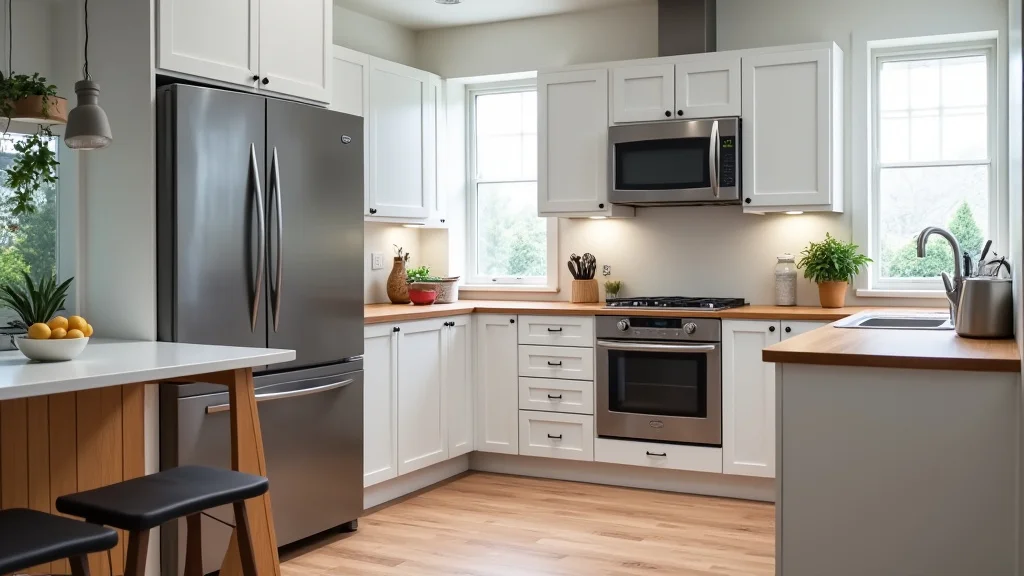
Tired of that old, sputtering refrigerator or the oven that takes forever to heat up? You’re not alone. Many of us put off upgrading our kitchen appliances until they practically give up on us.
But imagine a kitchen where everything works perfectly, making cooking a joy instead of a chore. This guide will help you find the best deals during a kitchen appliances sale, ensuring you get top-quality items without breaking the bank. You’ll learn what to look for, when to buy, and how to make smart choices for your home.
Key Takeaways
- Recognize the best times of year to find significant discounts.
- Understand different types of kitchen appliances and their features.
- Learn how to compare brands and models effectively.
- Discover strategies for getting the most value during a sale event.
- Know where to look for reliable information and deals.
- Prepare your home for new appliance delivery and installation.
Smart Shopping For Kitchen Appliances Sale Events
Finding great deals on kitchen appliances can make a huge difference in your budget. A kitchen appliances sale is the perfect time to upgrade those tired items. This section covers when these sales typically happen and what makes them special opportunities for shoppers.
Knowing the timing can help you plan your purchases and secure the best prices.
When To Expect Major Sales
Major retailers and manufacturers often schedule sales around holidays and specific times of the year. These periods are designed to boost sales and clear out inventory. Planning your shopping around these dates can lead to substantial savings.
Keep an eye out for promotions that can reduce the overall cost of buying new appliances for your home.
-
Holiday Weekends Offer Deep Discounts
Holidays like Memorial Day, Fourth of July, Labor Day, and Black Friday are prime times for appliance sales. Stores offer significant markdowns to attract shoppers. You can often find 20% to 40% off on select models.
Sometimes, bundled deals are even better. For example, buying a refrigerator, range, and dishwasher together might offer an additional percentage off the total package. These sales are usually advertised weeks in advance, so starting your research early is key.
-
End-of-Year Clearance Events
As manufacturers prepare to release new models, older inventory is often discounted heavily. This typically happens in the late fall and early winter, leading up to the holiday season. You might find great deals on perfectly good, current-generation appliances.
These sales can be particularly good for refrigerators and dishwashers. Retailers want to make space for the latest designs and features, making it a buyer’s market. Look for “clearance” or “model year-end” sales.
-
Spring Refresh Sales
Spring is another popular time for home improvement, and appliance retailers often capitalize on this. Many sales occur in April and May. These promotions might not be as drastic as Black Friday, but they are still worth exploring.
You might find special financing offers or smaller discounts on popular items. This is a good time to upgrade if you need appliances before the summer cooking season.
Benefits Of Shopping During A Sale
The most obvious benefit of shopping during a kitchen appliances sale is the cost savings. You can get more for your money, allowing you to afford higher-end models or multiple appliances at once. Beyond just lower prices, these sales often come with other perks.
These might include free delivery, extended warranties, or special financing options. Taking advantage of these benefits means you get more value for your investment in your kitchen.
-
Significant Price Reductions
During a sale, prices can drop by hundreds or even thousands of dollars, depending on the appliance. A high-end French door refrigerator that normally costs $3,000 might be available for $2,400 or less. This allows you to equip your kitchen with appliances that were previously out of reach.
The savings are tangible and directly impact your budget. This makes upgrading your entire kitchen feel more achievable.
-
Bundled Deals And Packages
Retailers frequently offer package deals where buying multiple appliances together results in deeper discounts. For instance, purchasing a matching refrigerator, range, dishwasher, and microwave might earn you an extra 10% off the entire set. These bundles are perfect for a full kitchen remodel, ensuring a cohesive look and unified performance.
They simplify the buying process and provide excellent value.
-
Extended Warranties And Promotions
Sometimes, sales events include attractive warranty offers. You might get a free extended warranty for an extra year or two, which provides peace of mind. Other promotions could include free installation or haul-away of your old appliances.
These extras add considerable value and reduce the hassle of upgrading. Always check the fine print to see what additional benefits are included.
Understanding Kitchen Appliance Types And Features
Before you jump into a kitchen appliances sale, it’s important to know what you need. Different appliances serve distinct purposes, and their features vary widely. Understanding these differences helps you make informed decisions.
This section breaks down common kitchen appliances and highlights key features to consider. This knowledge will empower you to choose the best options for your cooking style and kitchen layout.
Refrigerators
Refrigerators are the heart of any kitchen. They keep food fresh and organized. There are several common configurations, each with its own pros and cons.
Think about your space, your family size, and how you use your fridge when choosing.
Types Of Refrigerators
-
Top-Freezer Refrigerators
These are the most traditional and often the most affordable. The freezer compartment is located above the refrigerator section. They are energy-efficient and typically have a smaller footprint.
They are a great choice for smaller kitchens or for those on a tight budget. Capacity usually ranges from 10 to 25 cubic feet.
-
Bottom-Freezer Refrigerators
In this design, the freezer is at the bottom, often as a pull-out drawer, while the refrigerator is at the top. This is convenient for frequent access to refrigerated items, as they are at eye level. They can be more ergonomic for daily use.
Capacities typically range from 15 to 27 cubic feet.
-
Side-By-Side Refrigerators
These models feature vertical freezer and refrigerator compartments next to each other. They offer easy access to both frozen and fresh foods. They are good for narrower kitchens because their doors require less swing space.
Many come with in-door ice and water dispensers. Capacities range from 18 to 30 cubic feet.
-
French Door Refrigerators
These are a very popular choice, featuring two doors for the refrigerator section opening from the center, with a pull-out freezer drawer below. They offer a wide refrigerator space for large platters and are aesthetically pleasing. They also often come with advanced features like filtered water dispensers and ice makers.
Capacities typically range from 18 to 32 cubic feet.
-
Counter-Depth Refrigerators
These are designed to sit flush with your cabinetry, offering a more integrated and built-in look. They are shallower than standard-depth models, which can affect storage capacity but improve kitchen flow. They are ideal for smaller kitchens where space is a premium.
Key Refrigerator Features
-
Capacity
Measured in cubic feet, capacity is crucial. A good rule of thumb is 4-6 cubic feet per adult in your household. For a family of four, a 20-24 cubic foot refrigerator is often sufficient.
Consider how much fresh and frozen food you typically store.
-
Energy Efficiency
Look for the ENERGY STAR label. ENERGY STAR certified refrigerators use at least 9% less energy than models that meet the minimum federal efficiency standard. Over the lifespan of the appliance, this can lead to significant savings on your electricity bill and is better for the environment.
-
Ice And Water Dispensers
Many models offer in-door or internal ice makers and filtered water dispensers. These are convenient but can increase the price and take up interior space. Consider if the added cost and space reduction are worth the convenience for your household.
-
Smart Features
Some advanced refrigerators offer Wi-Fi connectivity, allowing you to control temperature, get alerts, and even view interior contents via a smartphone app. These are typically found on higher-end models.
Ranges And Cooktops
The range is where the magic of cooking happens. You have choices based on fuel type and design. Each offers a different cooking experience.
Fuel Types For Ranges
-
Electric Ranges
These use electric heating elements. They are generally more affordable and easier to install as they only require an electrical outlet. Electric smoothtop surfaces are easy to clean.
However, they can take longer to heat up and cool down compared to gas.
-
Gas Ranges
These use natural gas or propane to fuel open flames. They offer precise temperature control, allowing for quick adjustments during cooking. Many professional chefs prefer gas for its responsiveness.
They require a gas line hookup.
-
Induction Ranges
A type of electric range, induction uses electromagnetic fields to heat cookware directly. This is incredibly efficient and fast, with precise temperature control. The cooktop itself stays relatively cool, making it safer and easier to clean.
Requires induction-compatible cookware.
Types Of Ranges And Cooktops
-
Freestanding Ranges
These are the most common type, featuring a cooktop and an oven in one unit. They can be placed anywhere in the kitchen and do not require custom cabinetry. They are available in electric, gas, and dual-fuel (gas cooktop with electric oven) options.
-
Slide-In Ranges
These are designed to fit into a standard 30-inch cutout in your countertop, with a slightly higher back panel that houses the controls. They offer a more built-in look than freestanding models and are easier to install than wall ovens and cooktops.
-
Drop-In Ranges
These models are installed directly into the countertop, with no back panel. They offer a very streamlined, integrated appearance. They require a more custom installation.
-
Cooktops
A cooktop is a separate unit installed directly into your countertop. It is paired with a separate wall oven. This offers more flexibility in kitchen design, allowing you to place the oven at a comfortable height.
They come in gas, electric, and induction.
Key Range Features
-
Burner Configuration
Consider the number and types of burners you need. Most electric ranges have four burners, while gas ranges often have five. Look for different sizes for various pot and pan needs.
Some gas ranges offer a central “power burner” for rapid boiling.
-
Oven Capacity And Features
Oven capacity is measured in cubic feet. For a standard family, 4 to 6 cubic feet is usually sufficient. Features like convection cooking (which circulates hot air for more even baking and faster cooking) can be very beneficial.
Self-cleaning functions are also a popular convenience.
-
Temperature Accuracy
For gas and standard electric ovens, temperature can sometimes fluctuate. Convection ovens generally offer more consistent temperatures. If baking is important to you, look for ovens with good temperature accuracy or those that have been highly rated for even cooking.
-
Warming Drawer
Some higher-end ranges include a warming drawer, which is useful for keeping food warm before serving. This adds another layer of convenience to your cooking experience.
Dishwashers
A dishwasher saves time and effort. Modern dishwashers are highly efficient and quiet. When choosing, consider noise levels, cleaning performance, and capacity.
Key Dishwasher Features
-
Noise Level
Measured in decibels (dB), a lower number means a quieter dishwasher. For open-plan living spaces, a quiet dishwasher is essential. Models below 50 dB are considered quiet, with some ultra-quiet models operating at 45 dB or less.
-
Wash Cycles And Options
Look for various wash cycles like Normal, Heavy Duty, Pots & Pans, and Quick Wash. Additional options like soil sensors (which adjust water usage based on how dirty the dishes are) and delayed start are also useful.
-
Drying Performance
Some dishwashers use heated drying elements, while others use condensation drying, which relies on the heat from the wash cycle to evaporate water. Stainless steel interiors often improve drying performance. Some models also use fans to assist drying.
-
Rack Adjustability
Adjustable upper racks allow you to make space for taller items in the lower rack or create more room for dishes. Some dishwashers also feature a third rack for silverware and small utensils, maximizing capacity.
-
Energy And Water Usage
Look for ENERGY STAR certification. These dishwashers use less water and energy than standard models, saving you money on utility bills and reducing environmental impact. The average ENERGY STAR dishwasher uses about 3.5 gallons of water per cycle.
Microwaves
Microwaves are convenient for reheating and quick cooking. They come in several forms.
Types Of Microwaves
-
Countertop Microwaves
These are the most common and portable. They can be placed on your counter or on a dedicated shelf. They are generally the most affordable.
Capacities vary, with most falling between 0.7 and 2.0 cubic feet.
-
Over-The-Range Microwaves
These mount above your range, combining a microwave with a vent hood and often a light for the stovetop. They save counter space and are ideal for smaller kitchens. They require proper ventilation installation.
-
Built-In Microwaves
These are designed to be integrated into cabinetry, often with a trim kit for a seamless look. They offer a sophisticated appearance but are more expensive and require precise installation.
-
Drawer Microwaves
Installed under a counter or in a wall cabinet, these pull out like a drawer. They offer a unique, modern look and convenient access. They are typically found in higher-end kitchens.
Key Microwave Features
-
Wattage
Higher wattage means faster cooking. Most standard microwaves are between 700 and 1200 watts. For quicker reheating and cooking, aim for 1000 watts or more.
-
Capacity
Measured in cubic feet, capacity determines how much food you can fit inside. Small microwaves (under 1.0 cu. ft.) are good for single servings, while larger ones (1.5 cu.
ft. and above) can handle family-sized meals or larger dishes.
-
Sensor Cooking
Sensor cooking automatically adjusts cooking time and power based on the food’s humidity. This helps prevent overcooking or undercooking. It’s a very convenient feature for reheating and cooking various items.
-
Convection Cooking
Some microwaves have a convection feature, turning them into a small oven. This allows for baking, roasting, and browning in addition to standard microwave functions.
Other Kitchen Appliances
Beyond the main items, consider smaller but essential appliances that can be part of a sale.
-
Stand Mixers
For bakers, a stand mixer is invaluable. They come in various sizes and power levels. Look for models with multiple attachments for versatility.
Brands like KitchenAid are well-known and durable.
-
Blenders
From smoothies to soups, a good blender is a kitchen workhorse. High-performance blenders can crush ice and make smooth purees. Consider the power (wattage) and jar material.
-
Food Processors
These are excellent for chopping, dicing, and pureeing ingredients quickly. Capacities vary, so choose one that fits your typical batch size.
Making The Most Of A Kitchen Appliances Sale
When a kitchen appliances sale rolls around, knowing how to shop smart is key. It’s not just about finding low prices; it’s about getting the best value for your needs. This section provides actionable strategies to help you secure excellent deals and make wise purchasing decisions.
Research Before You Buy
Don’t wait until the sale starts to begin your homework. The more prepared you are, the better your chances of snagging the best items at the lowest prices. Impulse buys during sales can sometimes lead to regret if you haven’t considered your needs carefully.
-
Define Your Needs
Before browsing, list the appliances you need and their most important features. What is your budget for each? What are your must-have functions versus nice-to-haves?
For example, if you rarely use your oven, a basic model might suffice. If you bake daily, you’ll need a high-performance oven with convection.
-
Read Reviews
Once you have a few models in mind, read user reviews and professional ratings. Websites like Consumer Reports, CNET, and even retailer sites offer valuable insights into performance, durability, and potential issues. Look for patterns in feedback.
A recurring problem with a specific model is a red flag.
-
Compare Prices
Keep track of prices for the models you’re interested in leading up to the sale. Some retailers will match competitor prices or offer price protection if an item drops in price shortly after your purchase. This vigilance ensures you’re getting the best possible deal.
Compare Brands And Models
The appliance market has many brands, from budget-friendly to high-end luxury. Each has its strengths and weaknesses. Understanding these differences helps you choose a brand that aligns with your budget and quality expectations.
-
Brand Reputation
Well-known brands like Whirlpool, GE, Samsung, and LG often offer a good balance of features, reliability, and price. Some premium brands like Bosch, Miele, and Sub-Zero are known for superior performance and durability but come at a higher cost. Researching brand reliability is essential for long-term satisfaction.
A study by J.D. Power found that appliance customer satisfaction can be heavily influenced by perceived reliability and repair service quality.
-
Model Specifics
Within a brand, different models offer varying feature sets. A base model will lack advanced functions like smart connectivity or specialized cycles found in premium versions. Ensure the model you choose has the features you actually need, rather than paying for extras you won’t use.
-
Warranty And Support
Check the manufacturer’s warranty. Most appliances come with a one-year parts and labor warranty. Some brands offer longer warranties on specific components, like sealed refrigeration systems or oven elements.
Good customer support and readily available service technicians in your area are also important considerations.
Look For Bundles And Packages
As mentioned earlier, buying appliances as a set can unlock significant savings. When undertaking a kitchen remodel or replacing multiple appliances, look for these opportunities.
-
Kitchen Suites
Retailers often promote “kitchen suites” that include a matching refrigerator, range, dishwasher, and microwave. These packages are frequently discounted compared to buying individual pieces. They also ensure a consistent aesthetic throughout your kitchen, which can be very appealing.
-
Bundle Discounts
Even if you don’t buy a full suite, retailers might offer discounts for purchasing two or three major appliances together. For instance, buying a refrigerator and range might give you 10% off both. Always ask sales associates about current bundling promotions.
-
Third-Party Retailers
Beyond major appliance stores, check home improvement centers and even some online retailers for competitive package deals. Sometimes, these outlets have exclusive bundles or offer their own loyalty programs that add value.
Leverage Special Offers
Sales events are often accompanied by additional promotions that can further reduce the cost or add value.
-
Rebate Offers
Many manufacturers offer mail-in rebates, especially during holiday sales. These rebates can take a significant amount off the price, but remember to factor in the time and effort to submit the rebate. Always keep copies of your purchase receipt and the rebate form.
Some rebates offer savings of $100 to $500 on select appliances.
-
Financing Options
Zero-percent interest financing for a set period (e.g., 12, 18, or 24 months) can make expensive purchases more manageable. Be sure to understand the terms and conditions, including what happens if you miss a payment. This can save you money on interest compared to using a credit card.
-
Trade-In Programs
Some retailers or manufacturers offer trade-in programs for your old appliances. While the trade-in value might not be huge, it’s an easy way to dispose of your old unit and get a small discount on a new one.
Delivery And Installation Considerations
Once you’ve made your purchase, think about how the new appliances will get into your home and get working.
-
Delivery Fees
Check if delivery is included or if there’s a separate charge. For large appliances, delivery can be expensive. Many sales events include free delivery on purchases over a certain amount, or on bundled items.
Confirm the delivery window and any potential obstacles (e.g., narrow doorways, stairs) with the retailer.
-
Installation Services
Installation can also incur extra costs. Gas range installation requires a licensed professional, which adds to the expense. Dishwasher installation involves connecting water and drainage lines.
Over-the-range microwave installation needs electrical and venting hookups. Some retailers offer installation services, while others recommend third-party contractors. Read reviews for installation services carefully.
-
Haul-Away Of Old Appliances
Many retailers offer to haul away your old appliances for a fee or as part of a special promotion. This saves you the trouble of disposing of them properly. Ensure this service is included or available before you finalize your purchase.
Proper disposal is important for environmental reasons.
Common Myths Debunked
Myth 1: You Must Buy Everything New At Once
Many people believe that a kitchen remodel necessitates replacing all appliances simultaneously. While this is ideal for a cohesive look, it’s not always financially feasible. You can strategically upgrade one or two major appliances during a sale and plan to replace others later.
Focus on the appliance that needs replacement most urgently or offers the best deal.
Myth 2: Online Prices Are Always Lower
While online retailers offer convenience and often competitive pricing, brick-and-mortar stores frequently match or beat online prices, especially during major sales events. Furthermore, physical stores allow you to see, touch, and inspect appliances, which is crucial for items like refrigerators and ranges. You also have immediate access to sales staff for questions.
Myth 3: Black Friday Is The Only Time For Big Savings
Black Friday is famous for deals, but significant savings on kitchen appliances can be found throughout the year. Holiday weekends like Memorial Day, Labor Day, and even President’s Day often feature substantial discounts. End-of-year sales and specific promotional events by manufacturers can also yield great bargains.
Myth 4: All “Sale” Prices Are Genuine Discounts
Sometimes, retailers may inflate the “original” price to make the sale price appear more attractive. Always research the typical price of an appliance before the sale begins. Look for reputable review sites or price tracking tools to verify the authenticity of the discount.
Compare prices across multiple retailers.
Myth 5: High Price Always Means High Quality
While premium brands often use better materials and offer advanced features, a higher price tag doesn’t automatically guarantee superior quality or longevity for every appliance. Many mid-range brands offer excellent reliability and performance at a more accessible price point. Focus on features and reviews relevant to your needs, not just the price.
Frequently Asked Questions
Question: What is the best time of year to buy kitchen appliances?
Answer: The best times to find significant discounts on kitchen appliances are around major holidays like Memorial Day, Fourth of July, Labor Day, and Black Friday. End-of-year (late fall/early winter) and spring (April/May) also offer good opportunities due to inventory clearance and seasonal promotions.
Question: How can I ensure I get the best deal during a sale?
Answer: Research your desired appliances beforehand, compare prices across multiple retailers, look for bundle deals, and be aware of rebate offers and special financing. Act fast once a sale begins, as popular items can sell out quickly.
Question: Are bundled kitchen appliance deals worth it?
Answer: Yes, bundled deals are often very worthwhile. Buying a matching set of appliances (refrigerator, range, dishwasher, microwave) typically comes with significant discounts compared to purchasing each item individually. They also ensure a cohesive look for your kitchen.
Question: What should I do if my new appliance is damaged upon delivery?
Answer: Inspect the appliance thoroughly immediately upon delivery before signing any paperwork. If you notice any damage, document it with photos, note it on the delivery receipt, and contact the retailer as soon as possible to arrange for a
Question: Is free installation typically included in appliance sales?
Answer: Free installation is not always included but is sometimes offered as a promotion during major sales events, especially for items like dishwashers or over-the-range microwaves. It’s essential to check the specific terms of the sale and ask the retailer if installation is included or available for an additional fee.
Wrap Up
Finding great deals during a kitchen appliances sale is entirely achievable. By knowing when sales happen, researching thoroughly, and comparing options, you can outfit your kitchen with quality appliances without overspending. Take advantage of bundles, rebates, and special financing to maximize your savings and get the best value for your home.
Happy shopping!